
 KSGE


Search
- Page Path
- HOME > Search
Original Articles
-
Endoscopic resection of gastric gastrointestinal stromal tumor using clip-and-cut endoscopic full-thickness resection: a single-center, retrospective cohort in Korea

-
Yuri Kim
 , Ji Yong Ahn, Hwoon-Yong Jung, Seokin Kang, Ho June Song, Kee Don Choi, Do Hoon Kim, Jeong Hoon Lee, Hee Kyong Na, Young Soo Park
- Clin Endosc 2024;57(3):350-363. Published online February 15, 2024
- DOI: https://doi.org/10.5946/ce.2023.144
-
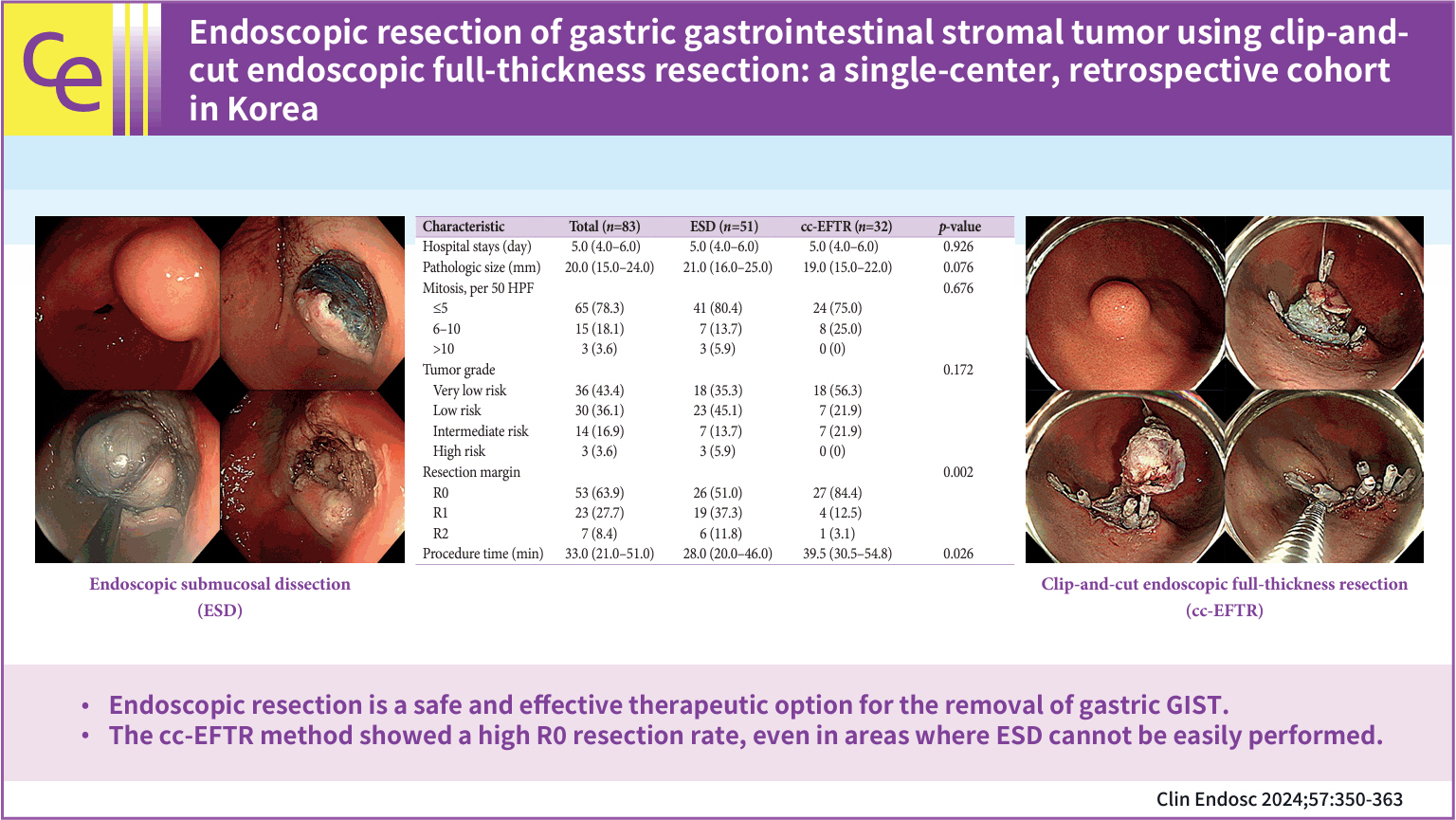
 Graphical Abstract
 Abstract
 PDF
 Supplementary Material
- Background
/Aims: To overcome the technical limitations of classic endoscopic resection for gastric gastrointestinal stromal tumors (GISTs), various methods have been developed. In this study, we examined the role and feasibility of clip-and-cut procedures (clip-and-cut endoscopic full-thickness resection [cc-EFTR]) for gastric GISTs.
Methods
Medical records of 83 patients diagnosed with GISTs after endoscopic resection between 2005 and 2021 were retrospectively reviewed. Moreover, clinical characteristics and outcomes were analyzed.
Results
Endoscopic submucosal dissection (ESD) and cc-EFTR were performed in 51 and 32 patients, respectively. The GISTs were detected in the upper third of the stomach for ESD (52.9%) and cc-EFTR (90.6%). Within the cc-EFTR group, a majority of GISTs were located in the deep muscularis propria or serosal layer, accounting for 96.9%, as opposed to those in the ESD group (45.1%). The R0 resection rates were 51.0% and 84.4% in the ESD and cc-EFTR groups, respectively. Seven (8.4%) patients required surgical treatment (six patients underwent ESD and one underwent cc-EFTR,) due to residual tumor (n=5) and post-procedure adverse events (n=2). Patients undergoing R0 or R1 resection did not experience recurrence during a median 14-month follow-up period, except for one patient in the ESD group.
Conclusions
cc-EFTR displayed a high R0 resection rate; therefore, it is a safe and effective therapeutic option for small gastric GISTs. -
Citations
Citations to this article as recorded by
- Clinical efficacy of endoscopic resection for subepithelial tumors in the esophagogastric junction and gastric cardia: an observational study
Sang Jin Park, Min A Yang, Jae Sun Song, Won Dong Lee, Myoung Jin Ju, Jin Woong Cho
Clinical Endoscopy.2026; 59(2): 245. CrossRef - Endoscopic Submucosal Dissection for Gastric Neoplasia: Scoping Review with ☸️SAIMSARA
SAIMSARA Journal.2026;[Epub] CrossRef - The Effectiveness and Safety of Endoscopic Intermuscular Dissection for the Treatment of Rectal Gastrointestinal Stromal Tumors: A Pilot Feasibility Study
Seong-Jung Kim, Eun Jeong Kim, Min Hyeok Lee, Jun Lee
Journal of Clinical Medicine.2026; 15(14): 5712. CrossRef - Clinical Outcomes of Traction-Assisted Endoscopic Submucosal Dissection for Prepyloric and Pyloric Neoplasms: Propensity Score Matching Analysis
Seung Min Hong, Gwang Ha Kim, Bong Eun Lee, Moon Won Lee, Dong Chan Joo, Dong Hoon Baek, Geun Am Song
Gut and Liver.2026; 20(5): 787. CrossRef - Advancements in Endoscopic Treatment for Gastric Subepithelial Tumors
Osamu Goto, Kazutoshi Higuchi, Eriko Koizumi, Katsuhiko Iwakiri
Gut and Liver.2025; 19(2): 151. CrossRef - Development and validation of an intraoperative perforation prediction scoring system for endoscopic resection of gastric gastrointestinal stromal tumors
Bin He, Jie Xu, Yunfu Feng, Chao Ma, Zhibing Wang, Xiaodan Xu, Luojie Liu, Ye Ye
Surgical Endoscopy.2025; 39(10): 6655. CrossRef - Natural History of Gastric Subepithelial Tumors: Long-Term Outcomes and Surveillance Strategies
Hye Kyung Jeon, Gwang Ha Kim
Journal of Clinical Medicine.2025; 14(18): 6354. CrossRef - Endoscopic resection penetrating the muscularis propria for gastric gastrointestinal stromal tumors: advances and challenges
Jin Woong Cho
Clinical Endoscopy.2024; 57(3): 329. CrossRef
- Clinical efficacy of endoscopic resection for subepithelial tumors in the esophagogastric junction and gastric cardia: an observational study
- 15,618 View
- 260 Download
- 7 Web of Science
- 8 Crossref

- Outcomes of endoscopic submucosal dissection for superficial esophageal neoplasms in patients with liver cirrhosis
-
Young Kwon Choi, Jin Hee Noh, Do Hoon Kim, Hee Kyong Na, Ji Yong Ahn, Jeong Hoon Lee, Kee Wook Jung, Kee Don Choi, Ho June Song, Gin Hyug Lee, Hwoon-Yong Jung
- Clin Endosc 2022;55(3):381-389. Published online April 20, 2022
- DOI: https://doi.org/10.5946/ce.2021.242

-
Abstract
PDFSupplementary Material
- Background
/Aims: The treatment of superficial esophageal neoplasms (SENs) in cirrhotic patients is challenging and rarely investigated. We evaluated the outcomes of endoscopic submucosal dissection (ESD) to determine the efficacy and safety of treating SENs in patients with liver cirrhosis.
Methods
The baseline characteristics and treatment outcomes of patients who underwent ESD for SENs between November 2005 and December 2017 were retrospectively reviewed.
Results
ESD was performed in 437 patients with 481 SENs, including 15 cirrhotic patients with 17 SENs. En bloc resection (88.2% vs. 97.0%) and curative resection (64.7% vs. 78.9%) rates were not different between the cirrhosis and non-cirrhosis groups (p=0.105 and p=0.224, respectively). Bleeding was more common in cirrhotic patients (p=0.054), and all cases were successfully controlled endoscopically. The median procedure and hospitalization duration did not differ between the groups. Overall survival was lower in cirrhotic patients (p=0.003), while disease-specific survival did not differ between the groups (p=0.85).
Conclusions
ESD could be a safe and effective treatment option for SENs in patients with cirrhosis. Detailed preprocedural assessments are needed, including determination of liver function, esophageal varix status, and remaining life expectancy, to identify patients who will obtain the greatest benefit. -
Citations
Citations to this article as recorded by- Endoscopic resection of early esophageal neoplasia in patients with esophageal varices: a systematic review
Charlotte N. Frederiks, Laura S. Boer, Bas Gloudemans, Lorenza Alvarez Herrero, Jacques J.G.H.M. Bergman, Roos E. Pouw, Bas L.A.M. Weusten
Endoscopy.2025; 57(07): 769. CrossRef - Clinical outcomes of endoscopic submucosal dissection for esophageal squamous cell carcinoma with esophageal varices: Multicenter retrospective study
Yosuke Toya, Waku Hatta, Tomohiro Shimada, Tamotsu Matsuhashi, Takeharu Shiroki, Yu Sasaki, Tetsuya Tatsuta, Jun Nakamura, Norihiro Hanabata, Yohei Horikawa, Ko Nagino, Tomoyuki Koike, Atsushi Masamune, Yoshihiro Harada, Tetsuya Ohira, Katsunori Iijima, Y
Digestive Endoscopy.2024; 36(3): 314. CrossRef - Clinical outcomes of endoscopic submucosal dissection for superficial esophageal neoplasia in close proximity to esophageal varices: a multicenter international experience
Shruti Mony, Bing Hu, Abel Joseph, Hiroyuki Aihara, Lorenzo Ferri, Amit Bhatt, Amit Mehta, Peng-Sheng Ting, Alex Chen, Andrew Kalra, Jad Farha, Manabu Onimaru, Long He, Qi Luo, Andrew Y. Wang, Haruhiro Inoue, Saowanee Ngamruengphong
Endoscopy.2024; 56(02): 119. CrossRef - Risk associated with endoscopic treatment of early upper gastrointestinal cancer in patients with liver cirrhosis and management strategies
Yu-Yong Tan, Yu-Min Qing, Jian Gong, De-Liang Liu
World Chinese Journal of Digestology.2024; 32(2): 102. CrossRef - Radical chemoradiotherapy for superficial esophageal cancer complicated with liver cirrhosis
Hejing Bao, Hehong Bao, Liping Lin, Yuhuan Wang, Longbin Zhang, Li Zhang, Han Zhang, Lingxiang Liu, Xiaolong Cao
PeerJ.2024; 12: e18065. CrossRef - Endoscopic management of early esophageal cancer in patients with concomitant cirrhosis
Linlin Zhu, Zhenming Zhang
Chinese Medical Journal.2024; 137(24): 3142. CrossRef - Endoscopic submucosal dissection for early cancers or precancerous lesions of the upper GI tract in cirrhotic patients with esophagogastric varices: 10-year experience from a large tertiary center in China
Shuai Zhang, Ying-Di Liu, Ning-Li Chai, Yi Yao, Fei Gao, Bo Liu, Zhan-Di He, Lu Bai, Xin Huang, Chao Gao, En-Qiang Linghu, Lian-Yong Li
Gastrointestinal Endoscopy.2023; 97(6): 1031. CrossRef - Endoscopic Submucosal Dissection for Treatment of Early-Stage Cancer or Precancerous Lesion in the Upper Gastrointestinal Tract in Patients with Liver Cirrhosis
Yuyong Tan, Yumin Qing, Deliang Liu, Jian Gong
Journal of Clinical Medicine.2023; 12(20): 6509. CrossRef
- Endoscopic resection of early esophageal neoplasia in patients with esophageal varices: a systematic review
- 7,074 View
- 175 Download
- 7 Web of Science
- 8 Crossref
- Clinical Outcomes of Percutaneous Endoscopic Gastrostomy in the Surgical Intensive Care Unit
-
Gyu Young Pih, Hee Kyong Na, Suk-Kyung Hong, Ji Yong Ahn, Jeong Hoon Lee, Kee Wook Jung, Do Hoon Kim, Kee Don Choi, Ho June Song, Gin Hyug Lee, Hwoon-Yong Jung
- Clin Endosc 2020;53(6):705-716. Published online March 31, 2020
- DOI: https://doi.org/10.5946/ce.2019.196

-
Abstract
PDF
- Background
/Aims: Percutaneous endoscopic gastrostomy (PEG) is usually performed on patients with chronic underlying diseases in the general ward (GW). This study evaluated the clinical outcomes of PEG performed on patients in the surgical intensive care unit (SICU) compared with those of PEG performed in the GW.
Methods
The medical records of 27 patients in the SICU and 263 in the GW, who underwent PEG between January 2013 and July 2017, were retrospectively reviewed.
Results
The median age of the 27 SICU patients was 66 years, and their median body mass index was 21.1 kg/m2. In the SICU group, the median baseline Sequential Organ Failure Assessment (SOFA) score was 4, and the median Acute Physiology and Chronic Health Evaluation II (APACHE II) score was 16. The median interval between surgery and PEG in SICU patients was 30 days, with a PEG failure rate of 3.7%. Acute complications in SICU patients included bleeding (7.4%) and ileus (11.1%), while chronic complications included aspiration pneumonia (7.4%) and tube obstruction (3.7%). The rates of acute and chronic complications did not differ significantly between the SICU and GW groups. The 30-day mortality rate was 14.8% in SICU patients and 5.3% in GW patients (p=0.073).
Conclusions
PEG is a safe and feasible method of enteral feeding for critically ill patients who require ICU care after surgery. -
Citations
Citations to this article as recorded by- Pre-procedural predictors of in-hospital mortality in ICU patients undergoing endoscopic PEG placement
Mustafa Oruç, Eda Şahingöz, Ece Canpolat, Tezcan Akın, Serdar Gökay Terzioğlu, Erdinç Çetinkaya
Turkish Journal of Surgery.2026;[Epub] CrossRef - Endoscopic gastrostomy as a method of enteral nutrition providing
E. A. Drobyazgin, Yu. V. Chikinev, A. V. Korobeynikov, A. S. Polyakevich, I. V. Peshkova, S. G. Stofin
Filin’s Clinical endoscopy.2025; 67(1): 54. CrossRef - Comparative Outcomes of PEG Patients With and Without Hypoxia: Laboratory Findings, Gastric Biopsy Results and Procedural Sedation Practices
Aysegul Torun Goktas, Ali Muhtaroglu, Ersin Kuloglu, Ahmet Cumhur Dulger
Medical Science and Discovery.2025; 12(3): 93. CrossRef - The impact of incidental endoscopic findings on PEG-related complications in critically ill patients
Özkul Yılmaz Çolak, Neslihan Ünal Akdemir, Melda İşevi, Tuğçehan Sezer Akman, Fatma Ülger
Turkish Journal of Intensive Care.2025; 24(2): 107. CrossRef - Clinical Practice Guideline for Percutaneous Endoscopic Gastrostomy
Chung Hyun Tae, Ju Yup Lee, Moon Kyung Joo, Chan Hyuk Park, Eun Jeong Gong, Cheol Min Shin, Hyun Lim, Hyuk Soon Choi, Miyoung Choi, Sang Hoon Kim, Chul-Hyun Lim, Jeong-Sik Byeon, Ki-Nam Shim, Geun Am Song, Moon Sung Lee, Jong-Jae Park, Oh Young Lee
Gut and Liver.2024; 18(1): 10. CrossRef - A Multicenter Survey of Percutaneous Endoscopic Gastrostomy in 2019 at Korean Medical Institutions
Jun Woo Park, Tae Gyun Kim, Kwang Bum Cho, Jeong Seok Kim, Jin Woong Cho, Jung Won Jeon, Sun Gyo Lim, Chan Gyoo Kim, Hong Jun Park, Tae Jun Kim, Eun Sun Kim, Su Jin Jeong, Yong Hwan Kwon
Gut and Liver.2024; 18(1): 77. CrossRef - Clinical practice guidelines for percutaneous endoscopic gastrostomy
Chung Hyun Tae, Ju Yup Lee, Moon Kyung Joo, Chan Hyuk Park, Eun Jeong Gong, Cheol Min Shin, Hyun Lim, Hyuk Soon Choi, Miyoung Choi, Sang Hoon Kim, Chul-Hyun Lim, Jeong-Sik Byeon, Ki-Nam Shim, Geun Am Song, Moon Sung Lee, Jong-Jae Park, Oh Young Lee
Clinical Endoscopy.2023; 56(4): 391. CrossRef - Risk factors and natural history of bedside percutaneous endoscopic versus fluoroscopy-guided gastrostomy tubes in intensive care unit patients
Lucy Ching Chau, Ryan Soheim, Michael Dix, Sarah Chung, Nadia Obeid, Arielle Hodari-Gupta, Cletus Stanton
Surgical Endoscopy.2023; 37(11): 8742. CrossRef - Clinical Practice Guideline for Percutaneous Endoscopic Gastrostomy
Chung Hyun Tae, Ju Yup Lee, Moon Kyung Joo, Chan Hyuk Park, Eun Jeong Gong, Cheol Min Shin, Hyun Lim, Hyuk Soon Choi, Miyoung Choi, Sang Hoon Kim, Chul-Hyun Lim, Jeong-Sik Byeon, Ki-Nam Shim, Geun Am Song, Moon Sung Lee, Jong-Jae Park, Oh Young Lee
The Korean Journal of Gastroenterology.2023; 82(3): 107. CrossRef - Relative contraindications to percutaneous endoscopic gastrostomy (review of literature)
Yu. O. Zharikov, M. Kh. Gurtsiev, S. Zh. Antonyan, S. F. Askerova, E. I. Chairkina, P. A. Yartsev
Grekov's Bulletin of Surgery.2022; 180(6): 105. CrossRef
- Pre-procedural predictors of in-hospital mortality in ICU patients undergoing endoscopic PEG placement
- 9,951 View
- 165 Download
- 8 Web of Science
- 10 Crossref
- Long-Term Survival and Tumor Recurrence in Patients with Superficial Esophageal Cancer after Complete Non-Curative Endoscopic Resection: A Single-Center Case Series
-
Ji Wan Lee, Charles J. Cho, Do Hoon Kim, Ji Yong Ahn, Jeong Hoon Lee, Kee Don Choi, Ho June Song, Sook Ryun Park, Hyun Joo Lee, Yong Hee Kim, Gin Hyug Lee, Hwoon-Yong Jung, Sung-Bae Kim, Jong Hoon Kim, Seung-Il Park
- Clin Endosc 2018;51(5):470-477. Published online June 1, 2018
- DOI: https://doi.org/10.5946/ce.2018.025
-
Abstract
PDF
- Background
/Aims: To report the long-term survival and tumor recurrence outcomes in patients with superficial esophageal cancer (SEC) after complete non-curative endoscopic resection (ER).
Methods
We retrieved ER data for 24 patients with non-curatively resected SEC. Non-curative resection was defined as the presence of submucosal and/or lymphovascular invasion on ER pathology. Relevant clinical and tumor-specific parameters were reviewed.
Results
The mean age of the 24 study patients was 66.3±8.3 years. Ten patients were closely followed up without treatment, while 14 received additional treatment. During a mean follow-up of 59.0±33.2 months, the 3- and 5-year survival rates of all cases were 90.7% and 77.6%, respectively. The 5-year overall survival rates were 72.9% in the close observation group and 82.1% in the additional treatment group (p=0.958). The 5-year cumulative incidences of all cases of recurrence (25.0% vs. 43.3%, p=0.388), primary EC recurrence (10.0% vs. 16.4%, p=0.558), and metachronous EC recurrence (16.7% vs. 26.7%, p=0.667) were similar between the two groups.
Conclusions
Patients with non-curatively resected SEC showed good long-term survival outcomes. Given the similar oncologic outcomes, close observation may be an option with appropriate caution taken for patients who are medically unfit to receive additional therapy. -
Citations
Citations to this article as recorded by- Predicting the magnitude of risk for non-curative endoscopic submucosal dissection in superficial esophageal cancer using explainable artificial intelligence
Zi-Chen Luo, Hai-Yang Guo, Xiao Tang, Xin-Rui Chen, Cheng-Yu Zhang, Yu-Tong Cui, Ji Zuo, Hao-Rui Li, Xue-Mei Hou, Hao Chen, Shao-Bi Song, Xian-Fei Wang
World Journal of Gastrointestinal Oncology.2026;[Epub] CrossRef - Comparative efficacy and outcomes of different treatments for pathologically high-risk superficial esophageal cancer: a systematic review and network meta-analysis
Hongzhi He, Hanlu Zhang, Haowen Lv, Ningying Ding, Wenping Wang
Frontiers in Oncology.2026;[Epub] CrossRef - Non-Curative Endoscopic Submucosal Dissection: Current Concepts, Pitfalls and Future Perspectives
João Santos-Antunes
Journal of Clinical Medicine.2025; 14(7): 2488. CrossRef - Salvage Cryoballoon Ablation After Non-Curative Endoscopic Submucosal Dissection: The First Case Report on T1bN0M0 Esophageal Adenocarcinoma
Marianna Spinou, Eleni Nakou, Petros Zormpas, Antonis Pikoulas, George Tribonias
Reports.2025; 8(4): 265. CrossRef - Close Observation versus Additional Surgery after Noncurative Endoscopic Resection of Esophageal Squamous Cell Carcinoma
Byeong Geun Song, Ga Hee Kim, Charles J. Cho, Hyeong Ryul Kim, Yang Won Min, Hyuk Lee, Byung-Hoon Min, Ho June Song, Yong-Hee Kim, Jun Haeng Lee, Hwoon-Yong Jung, Jae Ill Zo, Young Mog Shim
Digestive Surgery.2021; 38(3): 247. CrossRef - Non-Curative Endoscopic Resection for Superficial Esophageal Cancer
Eun Hye Kim, Jun Chul Park
Clinical Endoscopy.2018; 51(5): 399. CrossRef
- Predicting the magnitude of risk for non-curative endoscopic submucosal dissection in superficial esophageal cancer using explainable artificial intelligence
- 9,951 View
- 154 Download
- 7 Web of Science
- 6 Crossref
Review
- Education and Training Guidelines for the Board of the Korean Society of Gastrointestinal Endoscopy
-
Hee Seok Moon, Eun Kwang Choi, Ji Hyun Seo, Jeong Seop Moon, Ho June Song, Kyoung Oh Kim, Jong Jin Hyun, Sung Kwan Shin, Beom Jae Lee, Sang Heon Lee
- Clin Endosc 2017;50(4):345-356. Published online July 31, 2017
- DOI: https://doi.org/10.5946/ce.2017.106
-
Abstract
PDF
- The Korean Society of Gastrointestinal Endoscopy (KSGE) developed a gastrointestinal (GI) endoscopy board in 1995 and related regulations. Although the KSGE has acquired many specialists since then, the education and training aims and guidelines were insufficient. During GI fellowship training, obtaining sufficient exposure to some types of endoscopic procedures is difficult. Fellows should acquire endoscopic skills through supervised endoscopic procedures during GI fellowship training. Thus, the KSGE requires training guidelines for fellowships that allow fellows to perform independent endoscopic procedures without supervision. This document is intended to provide principles that the Committee of Education and Training of the KSGE can use to develop practical guidelines for granting privileges to perform accurate GI endoscopy safely. The KSGE will improve the quality of GI endoscopy by providing guidelines for fellowships and supervisors.
-
Citations
Citations to this article as recorded by- Endoscopic retrograde cholangiopancreatography quality, credentialing, and facility standards: a systematic review of societal guidelines and recommendations
Nasruddin Sabrie, Paul D James, Natalia Causada-Calo, Nauzer Forbes, Jennifer J Telford, Olivia Meggetto, Christine Stogios, Ani Orchanian-Cheff , Marcus Vaska, Jill Tinmouth, Catherine Dubé, Rishad Khan
Journal of the Canadian Association of Gastroenterology.2026;[Epub] CrossRef - Core curriculum for sedation in gastrointestinal endoscopy with a focus on practice: a proposal from the Korean Society of Gastrointestinal Endoscopy
Hong Sub Lee, Yun Jeong Lim, Jong-Jae Park
Clinical Endoscopy.2025; 58(2): 218. CrossRef - Endoscopic retrograde cholangiopancreatography training and education
Jiann‐Hwa Chen, Hsiu‐Po Wang
Digestive Endoscopy.2024; 36(1): 74. CrossRef - Training in basic gastrointestinal endoscopic procedures: a European Society of Gastrointestinal Endoscopy (ESGE) and European Society of Gastroenterology and Endoscopy Nurses and Associates (ESGENA) Position Statement
Giulio Antonelli, Andrei M. Voiosu, Katarzyna M. Pawlak, Tiago Cúrdia Gonçalves, Nha Le, Michiel Bronswijk, Marcus Hollenbach, Omar Elshaarawy, Ulrike Beilenhoff, Pietro Mascagni, Theodor Voiosu, Maria Pellisé, Mário Dinis-Ribeiro, Konstantinos Triantafyl
Endoscopy.2024; 56(02): 131. CrossRef - Training in Advanced Endoscopy: Current Status and Future Directions
Sachin Wani, Rishad Khan, Peter V. Draganov, Catharine M. Walsh
Gastroenterology.2024; 167(5): 834. CrossRef - Interval Advanced Gastric Cancer After Negative Endoscopy
Tae Jun Kim, Jeung Hui Pyo, Young Hye Byun, Sung Chul Choi, Jin Pyo Hong, Yang Won Min, Hyuk Lee, Byung-Hoon Min, Poong-Lyul Rhee, Jae J. Kim, Jun Haeng Lee
Clinical Gastroenterology and Hepatology.2023; 21(5): 1205. CrossRef - Global trends in training and credentialing guidelines for gastrointestinal endoscopy: a systematic review
Nasruddin Sabrie, Rishad Khan, Samir Seleq, Hoomam Homsi, Nikko Gimpaya, Rishi Bansal, Michael A. Scaffidi, David Lightfoot, Samir C. Grover
Endoscopy International Open.2023; 11(02): E193. CrossRef - Needs assessment of basic gastrointestinal endoscopy training: A qualitative study in Indonesia
Hasan Maulahela, Nagita G Annisa, Marcellus Simadibrata, Ari F Syam, Ardi Findyartini, Wresti Indriatmi, Roy Soetikno
JGH Open.2023; 7(12): 928. CrossRef - A feasibility study of bending technology of motorized flexible gastroscope
Sukgyu Koh, Sungwan Kim
Journal of Innovative Medical Technology.2023; 1(1): 24. CrossRef - Gastrointestinal and non-gastrointestinal complication rates associated with diagnostic esophagogastroduodenoscopy under sedation
Ji Min Jang, Su Bee Park, Jin Young Yoon, Min Seob Kwak, Jae Myung Cha
Medicine.2022; 101(19): e29266. CrossRef - The First Systematic Gastroscopy Training Program for Surgeons in Korea
Ho Seok Seo, So Jung Kim, Chul Hyo Jeon, Kyo Young Song, Han Hong Lee
Journal of Korean Medical Science.2022;[Epub] CrossRef - Implementation effect of institutional policy of EGD observation time on neoplasm detection
Jae Myung Park, Sang Yoon Kim, Ga-Yeong Shin, Younghee Choe, Hyun Sun Cho, Chul-Hyun Lim, Yu Kyung Cho, Myung-Gyu Choi
Gastrointestinal Endoscopy.2021; 93(5): 1152. CrossRef - Training in endoscopic retrograde cholangio-pancreatography: a critical assessment of the broad scenario of training programs and models
Camilla Gallo, Ivo Boškoski, Maria Valeria Matteo, Beatrice Orlandini, Guido Costamagna
Expert Review of Gastroenterology & Hepatology.2021; 15(6): 675. CrossRef - Colonoscopy quality in community hospitals and nonhospital facilities in Korea
Jae Gon Lee, Dong Soo Han, Young-Eun Joo, Dae-Seong Myung, Dong Il Park, Seul Ki Kim, Yunho Jung, Won Hyun Lee, Eun Soo Kim, Joon Seok Yoon, Chang Soo Eun
The Korean Journal of Internal Medicine.2021; 36(Suppl 1): S35. CrossRef - Guidelines for accreditation of endoscopy units: quality measures from the Korean Society of Coloproctology
Rumi Shin, Seongdae Lee, Kyung-Su Han, Dae Kyung Sohn, Sang Hui Moon, Dong Hyun Choi, Bong-Hyeon Kye, Hae-Jung Son, Sun Il Lee, Sumin Si, Won-Kyung Kang
Annals of Surgical Treatment and Research.2021; 100(3): 154. CrossRef - Why Should We Implement a System of Endoscopic Retrograde Cholangiopancreatography Certification?
Kwang Bum Cho
The Korean Journal of Pancreas and Biliary Tract.2021; 26(4): 211. CrossRef - Process and Renewal of Pancreatobiliary Cerification System
Dong Wook Lee, Byoung Kwan Son
The Korean Journal of Pancreas and Biliary Tract.2020; 25(1): 1. CrossRef - Impact of Hospital Volume and the Experience of Endoscopist on Adverse Events Related to Endoscopic Retrograde Cholangiopancreatography: A Prospective Observational Study
Hyun Jik Lee, Chang Min Cho, Jun Heo, Min Kyu Jung, Tae Nyeun Kim, Kook Hyun Kim, Hyunsoo Kim, Kwang Bum Cho, Ho Gak Kim, Jimin Han, Dong Wook Lee, Yoon Suk Lee
Gut and Liver.2020; 14(2): 257. CrossRef - Quality indicators in diagnostic upper gastrointestinal endoscopy
Wladyslaw Januszewicz, Michal F. Kaminski
Therapeutic Advances in Gastroenterology.2020;[Epub] CrossRef - Optimized diagnosis ofHelicobacter pyloriand tailored eradication therapy for preventing gastric cancer: a proposal for SHAKE strategy
Jun-Hyung Cho, So-Young Jin
Expert Review of Gastroenterology & Hepatology.2020; 14(7): 553. CrossRef - Endoscopy training in Korea
Joon Sung Kim, Byung-Wook Kim
The Korean Journal of Internal Medicine.2019; 34(2): 237. CrossRef - Current Korean Medical Specialty and Subspecialty System for Preparation of Privileging and Credentialing of ERCP Subspecialty
Eun Kwang Choi
The Korean Journal of Pancreas and Biliary Tract.2019; 24(2): 47. CrossRef - Accredited Endoscopy Unit Program of Korea: Overview and Qualification
Jung-Wook Kim, Yu Kyung Cho, Jin-Oh Kim, Jae-Young Jang
Clinical Endoscopy.2019; 52(5): 426. CrossRef - ERCP practice beyond the training period – bridging the gap between guidelines and real-life practice: a single operator experience of 679 procedures
Theodor Voiosu, Andrei Voiosu, Andreea Benguş, Bogdan Mateescu
Romanian Journal of Internal Medicine.2019; 57(2): 151. CrossRef - Basic training in digestive endoscopy for resident physicians in gastroenterology. Recommendations by the Sociedad Española de Endoscopia Digestiva (SEED)
Álvaro Brotons, Angels Vilella, Cristina Sánchez-Montes, Catalina Garau, Albert Vila, Vicente Pons Beltrán, Carlos Dolz Abadía
Revista Española de Enfermedades Digestivas.2018;[Epub] CrossRef
- Endoscopic retrograde cholangiopancreatography quality, credentialing, and facility standards: a systematic review of societal guidelines and recommendations
- 14,640 View
- 278 Download
- 24 Web of Science
- 25 Crossref
Original Articles
- Characteristics of Missed Simultaneous Gastric Lesions Based on Double-Check Analysis of the Endoscopic Image
-
Eun Jeong Gong, Jeong Hoon Lee, Kyoungwon Jung, Charles J. Cho, Hee Kyong Na, Ji Yong Ahn, Kee Wook Jung, Do Hoon Kim, Kee Don Choi, Ho June Song, Gin Hyug Lee, Hwoon-Yong Jung, Jin-Ho Kim
- Clin Endosc 2017;50(3):261-269. Published online August 22, 2016
- DOI: https://doi.org/10.5946/ce.2016.056
-
Abstract
PDF
- Background
/Aims: The detection of multifocal lesions is important for the successful management of gastric neoplasms. We investigated the characteristics of missed simultaneous lesions and the reason for the missed diagnoses.
Methods
A total of 140 patients who underwent repeat endoscopy before endoscopic resection between June 2013 and June 2014 were retrospectively reviewed. We classified simultaneous lesions into three groups based on a review of earlier images: group 1, no images of the location of simultaneous lesions were taken; group 2, no corresponding lesion was evident in the previous images; and group 3, simultaneous lesions were visible in the earlier images but a biopsy was not performed.
Results
Simultaneous lesions were found in 12 patients (8.6%) with 13 lesions, comprising 10 dysplasia (76.9%) and three adenocarcinoma (23.1%). Regarding the reasons for missed diagnoses, seven lesions (53.8%) were classified as group 3, five (38.5%) as group 1, and the remaining lesion (7.7%) as group 2. There were no significant differences in the characteristics of the patients with and without simultaneous lesions.
Conclusions
Lesions disregarded or unnoticed during endoscopic examination were the main reason for missed diagnosis of simultaneous lesions. Endoscopists should consider the possibility of simultaneous lesions and attempt to meticulously evaluate the entire gastric mucosa. -
Citations
Citations to this article as recorded by- Real-time AI-assisted quality control during nasopharyngolaryngoscopy: a randomized controlled trial
Yun Li, Bin Ye, Yuanyuan Li, Cui Fan, Wenqing Chen, Yi Shuai, Bin Liu, Qiwei Liu, Kai Sun, Waner Zhang, Wujun Wang, Yalu Wang, Wenbin Lei, Mingliang Xiang
npj Digital Medicine.2026;[Epub] CrossRef - The effect of pre-procedural anxiety level on the quality of upper GI endoscopy in non-sedated patients: “can the need for sedation be predicted?”
Hulusi Can Karpuzcu, Görkem Yarbaş, Ramis Çatalbaş, Nur Aylin Atlı, Çağdaş Erdoğan
Therapeutic Advances in Gastroenterology.2025;[Epub] CrossRef - Artificial Intelligence as a Surrogate for Inspection Time to Assess Completeness in Esophagogastroduodenoscopy: A Prospective, Randomized, Noninferiority Study
Xia Tan, Liwen Yao, Zehua Dong, Yanxia Li, Yuanjie Yu, Xin Gao, Kai Zhu, Wenhao Su, Haisen Yin, Wen Wang, Chaijie Luo, Jialing Li, Hang You, Huiyan Hu, Wei Zhou, Honggang Yu
Clinical and Translational Gastroenterology.2025; 16(6): e00839. CrossRef -
Undifferentiated histology is associated with missed gastric cancer in individuals with prior
Helicobacter pylori
eradication undergoing screening endoscopy
Kenta Watanabe, So Takahashi, Sho Fukuda, Tatsuki Yoshida, Kodai Shirayama, Ryo Okubo, Takahiro Dohmen, Shusei Fujimori, Masato Funaoka, Saki Fushimi, Kotaro Sakaki, Kengo Onochi, Junichi Fujiwara, Takao Hoshino, Taira Kuramitsu, Toru Ishii, Yuki Sato, Ta
Scandinavian Journal of Gastroenterology.2025; 60(12): 1171. CrossRef -
Gastric dysplasia in random biopsies: the influence of
Helicobacter pylori
infection and alcohol consumption in the presence of a lesion
Ana Isabel Ferreira, Tiago Lima Capela, Vítor Macedo Silva, Sofia Xavier, Pedro Boal Carvalho, Joana Magalhães, José Cotter
Scandinavian Journal of Gastroenterology.2024; 59(2): 125. CrossRef - Protocolo de evaluación de las lesiones premalignas gástricas
A. Cerpa Arencibia, M. Tavecchia Castro, A. Burgos García, M.D. Martín-Arranz
Medicine - Programa de Formación Médica Continuada Acreditado.2024; 14(2): 104. CrossRef - Editorial: PPIs and gastric cancer – Are we dealing with a carcinogen? Authors' reply
Eun Jeong Gong, Hye‐Kyung Jung
Alimentary Pharmacology & Therapeutics.2023; 58(10): 1101. CrossRef - Development and evaluation of a double-check support system using artificial intelligence in endoscopic screening for gastric cancer
Hirotaka Oura, Tomoaki Matsumura, Mai Fujie, Tsubasa Ishikawa, Ariki Nagashima, Wataru Shiratori, Mamoru Tokunaga, Tatsuya Kaneko, Yushi Imai, Tsubasa Oike, Yuya Yokoyama, Naoki Akizue, Yuki Ota, Kenichiro Okimoto, Makoto Arai, Yuki Nakagawa, Mari Inada,
Gastric Cancer.2022; 25(2): 392. CrossRef - High Expression of Claudin-4 Is Associated with Synchronous Tumors in Patients with Early Gastric Cancer
Won Shik Kim, Hayeon Kim, Moon Kyung Joo, Byung Il Choi, Ah Young Yoo, Jong-Jae Park, Beom Jae Lee, Seung Han Kim, Hoon Jai Chun
Journal of Clinical Medicine.2022; 11(12): 3550. CrossRef - Assessment of Outcomes From 1-Year Surveillance After Detection of Early Gastric Cancer Among Patients at High Risk in Japan
Yoshinobu Yamamoto, Naohiro Yoshida, Tomonori Yano, Takahiro Horimatsu, Noriya Uedo, Noboru Kawata, Hiromitsu Kanzaki, Shinichiro Hori, Kenshi Yao, Seiichiro Abe, Chikatoshi Katada, Chizu Yokoi, Ken Ohata, Hisashi Doyama, Kenichi Yoshimura, Hideki Ishikaw
JAMA Network Open.2022; 5(8): e2227667. CrossRef - Preparation of image databases for artificial intelligence algorithm development in gastrointestinal endoscopy
Chang Bong Yang, Sang Hoon Kim, Yun Jeong Lim
Clinical Endoscopy.2022; 55(5): 594. CrossRef - Accuracy of artificial intelligence–assisted detection of upper GI lesions: a systematic review and meta-analysis
Thomas K.L. Lui, Vivien W.M. Tsui, Wai K. Leung
Gastrointestinal Endoscopy.2020; 92(4): 821. CrossRef - Common Locations of Gastric Cancer: Review of Research from the Endoscopic Submucosal Dissection Era
Su Jin Kim, Cheol Woong Choi
Journal of Korean Medical Science.2019;[Epub] CrossRef - Characteristics of Synchronous and Metachronous Multiple Gastric Tumors after Endoscopic Submucosal Dissection of Early Gastric Neoplasm
Hyun Jik Lee, Yoo Jin Lee, Ju Yup Lee, Eun Soo Kim, Woo Jin Chung, Byoung Kuk Jang, Kyung Sik Park, Jae Seok Hwang, Kwang Bum Cho
Clinical Endoscopy.2018; 51(3): 266. CrossRef - Cost Effectiveness of Gastric Cancer Screening According to Race and Ethnicity
Monica Saumoy, Yecheskel Schneider, Nicole Shen, Michel Kahaleh, Reem Z. Sharaiha, Shailja C. Shah
Gastroenterology.2018; 155(3): 648. CrossRef - Characteristics of Missed Synchronous Gastric Epithelial Neoplasms
Bong Eun Lee
Clinical Endoscopy.2017; 50(3): 211. CrossRef
- Real-time AI-assisted quality control during nasopharyngolaryngoscopy: a randomized controlled trial
- 12,901 View
- 194 Download
- 17 Web of Science
- 16 Crossref
- Yields and Utility of Endoscopic Ultrasonography-Guided 19-Gauge Trucut Biopsy versus 22-Gauge Fine Needle Aspiration for Diagnosing Gastric Subepithelial Tumors
- Hee Kyong Na, Jeong Hoon Lee, Young Soo Park, Ji Yong Ahn, Kwi-Sook Choi, Do Hoon Kim, Kee Don Choi, Ho June Song, Gin Hyug Lee, Hwoon-Yong Jung, Jin-Ho Kim
- Clin Endosc 2015;48(2):152-157. Published online March 27, 2015
- DOI: https://doi.org/10.5946/ce.2015.48.2.152
-
Abstract
PDF
Background/Aims To evaluate the yields and utility of 19-gauge (G) Trucut biopsy (TCB) versus 22 G fine needle aspiration (FNA) for diagnosing gastric subepithelial tumors (SETs).
Methods We retrieved data for 152 patients with a gastric SET larger than 2 cm who had undergone endoscopic ultrasonography (EUS)-guided 19 G TCB (
n =90) or 22 G FNA (n =62). Relevant clinical, tumor-specific, and EUS procedural information was reviewed retrospectively.Results A specific diagnosis was made for 76 gastrointestinal stromal tumors (GISTs) and 51 non-GIST SETs. The diagnostic yield of TCB was greater than that of FNA (77.8% vs. 38.7%,
p <0.001). The percentage of non-diagnostic specimens (suspicious and insufficient) was significantly lower in the TCB group (6.7% and 15.5%, respectively) than in the FNA group (22.6% and 38.7%, respectively; bothp <0.001). TCB accurately diagnosed 90.9% of GISTs and 81.1% of non-GIST SETs, whereas FNA accurately diagnosed 68.8% of GISTs and 14.3% of non-GIST SETs. There were nine technical failures with TCB, and the rate of adverse events did not differ between the groups (TCB vs. FNA, 3.3% vs. 8.1%;p =0.27).Conclusions Nineteen-gauge TCB is safe and highly valuable for diagnosing gastric SETs larger than 2 cm if technical failure can be avoided.
-
Citations
Citations to this article as recorded by- Research Value Analysis of Ultrasound-Guided Puncture in Precise Sampling for Gastrointestinal Stromal Tumor Biopsy
Jing Li, Xuemei He
Journal of Biosciences and Medicines.2026; 14(01): 73. CrossRef - Natural history of gastric leiomyoma
Kwangbeom Park, Ji Yong Ahn, Hee Kyong Na, Kee Wook Jung, Jeong Hoon Lee, Do Hoon Kim, Kee Don Choi, Ho June Song, Gin Hyug Lee, Hwwon-Yong Jung
Surgical Endoscopy.2024; 38(5): 2726. CrossRef - Diagnostic yield of endoscopic and EUS-guided biopsy techniques in subepithelial lesions of the upper GI tract: a systematic review
Cynthia A. Verloop, Jacqueline A.C. Goos, Marco J. Bruno, Rutger Quispel, Lydi M.J.W. van Driel, Lieke Hol
Gastrointestinal Endoscopy.2024; 99(6): 895. CrossRef - Comparison of endoscopic ultrasound‐guided fine needle aspiration cytology versus endoscopic biopsy for the diagnosis of subepithelial lesions of the upper and lower gastrointestinal tract: A 10‐year retrospective single institution analysis
Katrina Collins, Bianca Puello Yocum, Hector Mesa, Harvey Cramer, Omer Saeed
Diagnostic Cytopathology.2023; 51(7): 434. CrossRef - Utility of endoscopic ultrasonography-guided fine-needle biopsy (EUS-FNB) for diagnosing small subepithelial lesions (< 20 mm)
Masanari Sekine, Takaya Miura, Junichi Fujiwara, Takeshi Uehara, Takeharu Asano, Satohiro Matsumoto, Hiroyuki Miyatani, Hirosato Mashima
Journal of Ultrasound.2022; 25(1): 35. CrossRef - Advancements in the Diagnosis of Gastric Subepithelial Tumors
Osamu Goto, Mitsuru Kaise, Katsuhiko Iwakiri
Gut and Liver.2022; 16(3): 321. CrossRef - Necessity of Individualized Approach for Gastric Subepithelial Tumor Considering Pathologic Discrepancy and Surgical Difficulty Depending on the Gastric Location
Sung Gon Kim, Bang Wool Eom, Hongman Yoon, Myeong-Cheorl Kook, Young-Woo Kim, Keun Won Ryu
Journal of Clinical Medicine.2022; 11(16): 4733. CrossRef - Accuracy of visual on-site evaluation (Vose) In predicting the adequacy of Eus-guided fine needle biopsy: A single center prospective study
Serena Stigliano, Valerio Balassone, Dario Biasutto, Francesco Covotta, Marianna Signoretti, Francesco Maria Di Matteo
Pancreatology.2021; 21(1): 312. CrossRef - Utility of a 20G needle with a core trap in EUS-guided fine-needle biopsy for gastric submucosal tumors: A multicentric prospective trial
Ken Kamata, Akira Kurita, Satoru Yasukawa, Yasutaka Chiba, Hiroko Nebiki, Masanori Asada, Hiroaki Yasuda, Hideyuki Shiomi, Takeshi Ogura, Makoto Takaoka, Noriyuki Hoki, Reiko Ashida, Minoru Shigekawa, Akio Yanagisawa, Masatoshi Kudo, Masayuki Kitano
Endoscopic Ultrasound.2021; 10(2): 134. CrossRef - Endoscopic Resection of Gastrointestinal Stromal Tumor: Is It Safe?
Moon Kyung Joo
The Korean Journal of Helicobacter and Upper Gastrointestinal Research.2021; 21(3): 180. CrossRef - Efficacy of Endoscopic Ultrasound-Guided Fine-Needle Biopsy in Gastric Subepithelial Tumors Located in the Cardia
Ga Hee Kim, Ji Yong Ahn, Chung Sik Gong, Mimi Kim, Hee Kyong Na, Jeong Hoon Lee, Kee Wook Jung, Do Hoon Kim, Kee Don Choi, Ho June Song, Gin Hyug Lee, Hwoon-Yong Jung
Digestive Diseases and Sciences.2020; 65(2): 583. CrossRef - Comparison of the treatment outcomes of endoscopic and surgical resection of GI stromal tumors in the stomach: a propensity score–matched case-control study
Ga Hee Kim, Kee Don Choi, Chung Sik Gong, In-Seob Lee, Young Soo Park, Minkyu Han, Hee Kyong Na, Ji Yong Ahn, Jeong Hoon Lee, Kee Wook Jung, Do Hoon Kim, Ho June Song, Gin Hyug Lee, Hwoon-Yong Jung
Gastrointestinal Endoscopy.2020; 91(3): 527. CrossRef - EUS-guided fine-needle biopsy sampling versus FNA in the diagnosis of subepithelial lesions: a large multicenter study
Diogo T.H. de Moura, Thomas R. McCarty, Pichamol Jirapinyo, Igor B. Ribeiro, Victor K. Flumignan, Fedaa Najdawai, Marvin Ryou, Linda S. Lee, Christopher C. Thompson
Gastrointestinal Endoscopy.2020; 92(1): 108. CrossRef Gastrointestinal Stromal Tumors of the Small Intestine: Progress in Diagnosis and Treatment Research
Fangxing Peng, Yao Liu
Cancer Management and Research.2020; Volume 12: 3877. CrossRef- Prospective, multicenter, observational study of tissue acquisition through EUS-guided fine-needle biopsy using a 25G Franseen needle
Ryo Sugiura, Masaki Kuwatani, Kei Yane, Yoko Taya, Hideyuki Ihara, Manabu Onodera, Kazunori Eto, Itsuki Sano, Taiki Kudo, Tomoko Mitsuhashi, Akio Katanuma, Naoya Sakamoto
Endoscopic Ultrasound.2019; 8(5): 321. CrossRef - Randomized crossover trial comparing EUS‐guided fine‐needle aspiration with EUS‐guided fine‐needle biopsy for gastric subepithelial tumors
Tomohisa Iwai, Mitsuhiro Kida, Hiroshi Imaizumi, Shiro Miyazawa, Kosuke Okuwaki, Hiroshi Yamauchi, Toru Kaneko, Rikiya Hasegawa, Eiji Miyata, Wasaburo Koizumi
Diagnostic Cytopathology.2018; 46(3): 228. CrossRef - Endoscopic ultrasound-guided tissue acquisition of subepithelial masses
Jared J. Rejeski, Girish Mishra
Techniques in Gastrointestinal Endoscopy.2018; 20(1): 15. CrossRef - The diagnostic and cellularity yield of reverse bevel versus fork‐tip fine needle biopsy
Mohamed M Abdelfatah, Ahmed Hamed, Nicholas J. Koutlas, F. Zahra Aly
Diagnostic Cytopathology.2018; 46(8): 649. CrossRef - Endobronchial Ultrasound-guided Transbronchial Needle Aspiration With a 19-G Needle Device
Alain Tremblay, Seamus McFadden, Martina Bonifazi, Valentina Luzzi, Samuel V. Kemp, Stefano Gasparini, Alex Chee, Paul MacEachern, Elaine Dumoulin, Christopher A. Hergott, Pallav L. Shah
Journal of Bronchology & Interventional Pulmonology.2018; 25(3): 218. CrossRef - EUS-FNA WITH 19 OR 22 GAUGES NEEDLES FOR GASTRIC SUBEPITHELIAL LESIONS OF THE MUSCLE LAYER
César Vivian LOPES, Antônio Atalíbio HARTMANN, Everson Luiz de Almeida ARTIFON
ABCD. Arquivos Brasileiros de Cirurgia Digestiva (São Paulo).2018;[Epub] CrossRef - The role of EUS-guided fine needle aspiration in autoimmune pancreatitis: a single center prospective study
Li Cao, Yun Wang, Jinlin Wang, Qiaozhen Guo, Qian Chen, Xiaoli Wu, Shou-Jiang Tang, Bin Cheng
Scandinavian Journal of Gastroenterology.2018; 53(12): 1604. CrossRef - Feasibility of a 20-gauge ProCore needle in EUS-guided subepithelial tumor sampling: a prospective multicenter study
Do Hoon Kim, Gwang Ha Kim, Chang Min Cho, Chang Hwan Park, Soo-Young Na, Tae Hyeon Kim, Yu Kyung Cho, Ji Hyun Kim, Dong-Wan Seo
BMC Gastroenterology.2018;[Epub] CrossRef - Subepithelial rectal gastrointestinal stromal tumor – the use of endoscopic ultrasound-guided fine needle aspiration to establish a definitive cytological diagnosis: a case report
Vitor Ottoboni Brunaldi, Martin Coronel, Danielle Azevedo Chacon, Eduardo Turiani Hourneaux De Moura, Sérgio E. Matuguma, Eduardo Guimarães Hourneaux De Moura, Diogo Turiani Hourneaux De Moura
Journal of Medical Case Reports.2017;[Epub] CrossRef - GEIS guidelines for gastrointestinal sarcomas (GIST)
Andrés Poveda, Xavier García del Muro, Jose Antonio López-Guerrero, Ricardo Cubedo, Virginia Martínez, Ignacio Romero, César Serrano, Claudia Valverde, Javier Martín-Broto
Cancer Treatment Reviews.2017; 55: 107. CrossRef - The role of endoscopy in subepithelial lesions of the GI tract
Ashley L. Faulx, Shivangi Kothari, Ruben D. Acosta, Deepak Agrawal, David H. Bruining, Vinay Chandrasekhara, Mohamad A. Eloubeidi, Robert D. Fanelli, Suryakanth R. Gurudu, Mouen A. Khashab, Jenifer R. Lightdale, V. Raman Muthusamy, Aasma Shaukat, Bashar J
Gastrointestinal Endoscopy.2017; 85(6): 1117. CrossRef - Contrast‐enhanced harmonic endoscopic ultrasonography for differential diagnosis of submucosal tumors of the upper gastrointestinal tract
Ken Kamata, Mamoru Takenaka, Masayuki Kitano, Shunsuke Omoto, Takeshi Miyata, Kosuke Minaga, Kentaro Yamao, Hajime Imai, Toshiharu Sakurai, Tomohiro Watanabe, Naoshi Nishida, Takaaki Chikugo, Yasutaka Chiba, Haruhiko Imamoto, Takushi Yasuda, Andrea Lisott
Journal of Gastroenterology and Hepatology.2017; 32(10): 1686. CrossRef - How best to manage gastrointestinal stromal tumor
Gandhi Lanke, Jeffrey H Lee
World Journal of Clinical Oncology.2017; 8(2): 135. CrossRef - EUS-guided 22-gauge fine needle biopsy for the diagnosis of gastric subepithelial tumors larger than 2 cm
Jeong Hoon Lee, Charles J. Cho, Young Soo Park, Ji Yong Ahn, Do Hoon Kim, Hee Kyong Na, Kee Don Choi, Ho June Song, Gin Hyug Lee, Hwoon-Yong Jung
Scandinavian Journal of Gastroenterology.2016; 51(4): 486. CrossRef - Response:
Moon Kyung Joo, Jong-Jae Park
Gastrointestinal Endoscopy.2016; 83(4): 851. CrossRef - EUS-guided fine needle biopsy sampling using a novel fork-tip needle: a case-control study
Pujan Kandel, Ghassan Tranesh, Aziza Nassar, Russell Bingham, Massimo Raimondo, Timothy A. Woodward, Victoria Gomez, Michael B. Wallace
Gastrointestinal Endoscopy.2016; 84(6): 1034. CrossRef - Is Endoscopic Ultrasonography Adequate for the Diagnosis of Gastric Schwannomas?
Eun Jeong Gong, Kee Don Choi
Clinical Endoscopy.2016; 49(6): 498. CrossRef - A Case of Gastrointestinal Stromal Tumor That Underwent Endoscopic Ultrasound-Guided Aspiration with a 25-Gauge Biopsy Needle
Minoru Tomizawa, Fuminobu Shinozaki, Yasufumi Motoyoshi, Takao Sugiyama, Shigenori Yamamoto, Naoki Ishige
Case Reports in Gastroenterology.2016; 10(1): 173. CrossRef - Cytology of the gastrointestinal tract: opportunities to be tapped
Darshana Jhala
Diagnostic Histopathology.2015; 21(12): 462. CrossRef - Which Needle Is Better for Diagnosing Subepithelial Lesions?
Eun Young Kim
Clinical Endoscopy.2015; 48(2): 91. CrossRef
- Research Value Analysis of Ultrasound-Guided Puncture in Precise Sampling for Gastrointestinal Stromal Tumor Biopsy
- 13,431 View
- 138 Download
- 37 Web of Science
- 34 Crossref
- Comparison of Clinical Outcomes Associated with Pull-Type and Introducer-Type Percutaneous Endoscopic Gastrostomies
- Sin Won Lee, Jeong Hoon Lee, Hyungjin Cho, Yeonjung Ha, Hyun Lim, Ji Yong Ahn, Kwi Sook Choi, Do Hoon Kim, Kee Don Choi, Ho June Song, Gin Hyug Lee, Hwoon-Yong Jung, Jin-Ho Kim
- Clin Endosc 2014;47(6):530-537. Published online November 30, 2014
- DOI: https://doi.org/10.5946/ce.2014.47.6.530
-
Abstract
PDF
Background/Aims Percutaneous endoscopic gastrostomy (PEG) is a method of providing enteral nutrition using endoscopy. The PEG techniques differ according to the insertion method, and include the pull type, push type, and introducer type. The aim of this study was to compare the clinical outcomes associated with the pull-type and introducer-type PEG insertion techniques, which included the adverse events, at our tertiary care center in Korea.
Methods We retrospectively reviewed 141 cases that had undergone PEG insertion at our center from January 2009 to June 2012. The indications for PEG insertion and the acute and chronic complications caused by each type of PEG insertion were analyzed.
Results The indications for PEG insertion in our cohort included neurologic disease (58.7%), malignancy (21.7%), and other indications (19.6%). Successful PEG insertions were performed on 136 cases (96.5%), and there were no PEG-associated deaths. Bleeding was the most frequent acute complication (12.8%), and wound problems were the most frequent chronic complications (8.8%). There were no statistically significant differences between the pull-type and introducer-type PEG insertion techniques in relation to complication rates in our study population.
Conclusions PEG insertion is considered a safe procedure. The pull-type and introducer-type PEG insertion techniques produce comparable outcomes, and physicians may choose either of these approaches according to the circumstances.
-
Citations
Citations to this article as recorded by- Meta-analysis of clinical efficacy of percutaneous endoscopic gastrostomy vs percutaneous radiologic gastrostomy
Yun-Kai Hu, Bo-Wu He, Yu-Gang Su, Yong-Tang Chen, Qing-Jing Ru
World Chinese Journal of Digestology.2025; 33(5): 412. CrossRef - Single-step replacement of a push-type PEG with a pull-type PEG in a patient with dysphagia
Soo Bin Synn, Su Jin Kim
Journal of Innovative Medical Technology.2025; 3(2): 66. CrossRef - Clinical Practice Guideline for Percutaneous Endoscopic Gastrostomy
Chung Hyun Tae, Ju Yup Lee, Moon Kyung Joo, Chan Hyuk Park, Eun Jeong Gong, Cheol Min Shin, Hyun Lim, Hyuk Soon Choi, Miyoung Choi, Sang Hoon Kim, Chul-Hyun Lim, Jeong-Sik Byeon, Ki-Nam Shim, Geun Am Song, Moon Sung Lee, Jong-Jae Park, Oh Young Lee
Gut and Liver.2024; 18(1): 10. CrossRef - Clinical practice guidelines for percutaneous endoscopic gastrostomy
Chung Hyun Tae, Ju Yup Lee, Moon Kyung Joo, Chan Hyuk Park, Eun Jeong Gong, Cheol Min Shin, Hyun Lim, Hyuk Soon Choi, Miyoung Choi, Sang Hoon Kim, Chul-Hyun Lim, Jeong-Sik Byeon, Ki-Nam Shim, Geun Am Song, Moon Sung Lee, Jong-Jae Park, Oh Young Lee
Clinical Endoscopy.2023; 56(4): 391. CrossRef - Clinical Practice Guideline for Percutaneous Endoscopic Gastrostomy
Chung Hyun Tae, Ju Yup Lee, Moon Kyung Joo, Chan Hyuk Park, Eun Jeong Gong, Cheol Min Shin, Hyun Lim, Hyuk Soon Choi, Miyoung Choi, Sang Hoon Kim, Chul-Hyun Lim, Jeong-Sik Byeon, Ki-Nam Shim, Geun Am Song, Moon Sung Lee, Jong-Jae Park, Oh Young Lee
The Korean Journal of Gastroenterology.2023; 82(3): 107. CrossRef - Buried T-Bar after Gastrostomy Placement in Children
Soon Chul Kim
Indian Journal of Pediatrics.2022; 89(8): 833. CrossRef - Nationwide Survey for Pediatric Gastrostomy Tube Placement in Korea
Sangwoo Lee, Byung-Ho Choe, Ben Kang, Soon Chul Kim
Journal of Korean Medical Science.2022;[Epub] CrossRef - Clinical Outcomes of Enteral Feeding Protocol Via Percutaneous Endoscopic Gastrostomy: A Single‐Center, Retrospective Study
Jin Hee Noh, Hee Kyong Na, Ji Yong Ahn, Suk‐Kyung Hong, Jiyoun Kim, Jina Yang, Hwoon‐Yong Jung
Nutrition in Clinical Practice.2021; 36(1): 225. CrossRef - Relationship of early acute complications and insertion site in push method percutaneous endoscopic gastrostomy
Hiroshi Suzuki, Satoru Joshita, Tadanobu Nagaya, Koichi Sato, Akihiro Ito, Tomoaki Suga, Takeji Umemura
Scientific Reports.2020;[Epub] CrossRef - The efficacy of a novel percutaneous endoscopic gastrostomy simulator using three‐dimensional printing technologies
Hee Kyong Na, Ji Yong Ahn, Gin Hyug Lee, Jeong Hoon Lee, Do Hoon Kim, Kee Wook Jung, Kee Don Choi, Ho June Song, Hwoon‐Yong Jung
Journal of Gastroenterology and Hepatology.2019; 34(3): 561. CrossRef - A large prospective audit of morbidity and mortality associated with feeding gastrostomies in the community
Emily Clarke, Narrie Pitts, Andrew Latchford, Stephen Lewis
Clinical Nutrition.2017; 36(2): 485. CrossRef - Antibacterial gauzes are effective in preventing infections after percutaneous endoscopic gastrostomy placement
Denise Strijbos, Erik J. Schoon, Wouter Curvers, Pieter Friederich, Hajo J. Flink, Arnold Stronkhorst, Lennard P.L. Gilissen
European Journal of Gastroenterology & Hepatology.2016; 28(3): 297. CrossRef - Advances in nutritional delivery interventions
Bryan Silon, John C. Fang
Techniques in Gastrointestinal Endoscopy.2015; 17(4): 152. CrossRef
- Meta-analysis of clinical efficacy of percutaneous endoscopic gastrostomy vs percutaneous radiologic gastrostomy
- 11,186 View
- 104 Download
- 13 Web of Science
- 13 Crossref
Case Report
- Intralesional Steroid Injection to Prevent Stricture after Near-Circumferential Endosopic Submucosal Dissection for Superficial Esophageal Cancer
- Wook Jin Lee, Hwoon-Yong Jung, Do Hoon Kim, Jeong Hoon Lee, Kee Don Choi, Ho June Song, Gin Hyug Lee, Jin-Ho Kim
- Clin Endosc 2013;46(6):643-646. Published online November 19, 2013
- DOI: https://doi.org/10.5946/ce.2013.46.6.643
-
Abstract
PDF
Stricture frequently occurs after endoscopic submucosal dissection (ESD) for superficial esophageal carcinoma with near- or whole-circumferential mucosal defects, and post-ESD stricture is difficult to treat and usually requires multiple sessions of endoscopic balloon dilatation. Intralesional steroid injection has previously been used to prevent stricture; however, there have been few experiences with this method after near- or whole-circumferential ESD. We present a case of a single session of intralesional steroid injection performed immediately after near-circumferential ESD to prevent post-ESD stricture. After a follow-up period of 6 months, the patient showed good outcome without dysphagia.
-
Citations
Citations to this article as recorded by- Endoscopic radial incision combined with local injection of triamcinolone acetonide for refractory esophageal stenosis after endoscopy submucosal dissection
Hoi-Ioi Ng, Yi Liu, Yong Liu, Li-Zhou Dou, Shun He, Gui-Qi Wang
Updates in Surgery.2026; 78(3): 1095. CrossRef - Characterization and Management of Benign Esophageal Strictures
Varun Teja Angajala, Danielle Bellavance, Justin Lee, Hiroshi Mashimo
Annals of the New York Academy of Sciences.2026;[Epub] CrossRef - Recent Advances of Biomedical Materials for Prevention of Post-ESD Esophageal Stricture
Yuchen Bao, Zhenguang Li, Yingze Li, Tao Chen, Yu Cheng, Meidong Xu
Frontiers in Bioengineering and Biotechnology.2021;[Epub] CrossRef - Evaluation of human keratinocyte sheets transplanted onto porcine excised esophagus after submucosal dissection in an ex vivo model
Yosuke Kawai, Ryo Takagi, Takeshi Ohki, Masakazu Yamamoto, Masayuki Yamato
Regenerative Therapy.2020; 15: 323. CrossRef - White coat status is a predictive marker for post-esophageal endoscopic submucosal dissection stricture: a retrospective study
Keitaro Takahashi, Mikihiro Fujiya, Nobuhiro Ueno, Takeshi Saito, Yuya Sugiyama, Yuki Murakami, Takuya Iwama, Takahiro Sasaki, Masami Ijiri, Kazuyuki Tanaka, Aki Sakatani, Katsuyoshi Ando, Yoshiki Nomura, Shin Kashima, Mitsuru Goto, Kentaro Moriichi, Tosh
Esophagus.2019; 16(3): 258. CrossRef - Roles of Steroids in Preventing Esophageal Stricture after Endoscopic Resection
Yu Qiu, Ruihua Shi
Canadian Journal of Gastroenterology and Hepatology.2019; 2019: 1. CrossRef - Long-term outcomes of a primary complete endoscopic resection strategy for short-segment Barrett’s esophagus with high-grade dysplasia and/or early esophageal adenocarcinoma
Farzan F. Bahin, Mahesh Jayanna, Luke F. Hourigan, Reginald V. Lord, David Whiteman, Stephen J. Williams, Eric Y.T. Lee, Michael J. Bourke
Gastrointestinal Endoscopy.2016; 83(1): 68. CrossRef - Endoscopic submucosal tunnel dissection for a large esophageal subepithelial leiomyoma to prevent postprocedural stenosis
Wen‐Hsin Hsu, Meng‐Shun Sun, Hoi‐Wan Lo, Ching‐Yang Tsai, Yu‐Jou Tsai
Advances in Digestive Medicine.2016; 3(3): 115. CrossRef - Endoscopic Submucosal Dissection for Superficial Esophageal Neoplasm: A Growing Body of Evidence
Eun Jeong Gong, Hwoon-Yong Jung
Clinical Endoscopy.2016; 49(2): 101. CrossRef - Esophageal Stricture Prevention after Endoscopic Submucosal Dissection
Deepanshu Jain, Shashideep Singhal
Clinical Endoscopy.2016; 49(3): 241. CrossRef - Ten-year experience of esophageal endoscopic submucosal dissection of superficial esophageal neoplasms in a single center
Hyung Chul Park, Do Hoon Kim, Eun Jeong Gong, Hee Kyong Na, Ji Yong Ahn, Jeong Hoon Lee, Kee Wook Jung, Kee Don Choi, Ho June Song, Gin Hyug Lee, Hwoon-Yong Jung, Jin-Ho Kim
The Korean Journal of Internal Medicine.2016; 31(6): 1064. CrossRef - Systematic review: the prevention of oesophageal stricture after endoscopic resection
M. Barret, B. Beye, S. Leblanc, F. Beuvon, S. Chaussade, F. Batteux, F. Prat
Alimentary Pharmacology & Therapeutics.2015; 42(1): 20. CrossRef - Endoscopic cell sheet transplantation device developed by using a 3-dimensional printer and its feasibility evaluation in a porcine model
Masanori Maeda, Nobuo Kanai, Shinichiro Kobayashi, Takahiro Hosoi, Ryo Takagi, Takashi Ohki, Yoshihiro Muragaki, Masayuki Yamato, Susumu Eguchi, Fumio Fukai, Teruo Okano
Gastrointestinal Endoscopy.2015; 82(1): 147. CrossRef
- Endoscopic radial incision combined with local injection of triamcinolone acetonide for refractory esophageal stenosis after endoscopy submucosal dissection
- 10,671 View
- 98 Download
- 13 Crossref
 First
 Prev





